A UPS — an Uninterruptible Power Supply — is the device that sits between your wall outlet and your equipment, acting as an instant-on battery buffer the moment the power flickers or fails. Think of it as the emergency layer that activates before you even notice the lights blinked. For anyone running a NAS (network-attached storage — essentially a personal file server), a workstation, or a home-office stack, a UPS is the last line of defense between a power event and corrupted data or a dead hard drive. The decision most buyers don’t realize they’re making is about the battery chemistry inside: traditional lead-acid (the same basic technology that starts your car) or the newer LiFePO4 (lithium iron phosphate — a stable, long-lived variant of lithium-ion). That chemistry choice will determine how much you spend over a decade, not just at checkout.
If you’re reading this with a purchasing decision already in motion, here’s the short version: lead-acid UPS units from APC and CyberPower dominate the installed base and deliver solid value at the point of purchase. LiFePO4 units cost more upfront but restructure the total-cost-of-ownership math over a 7–10 year horizon. This guide will show you exactly how to run that calculation for your specific load — and which type of buyer each chemistry actually fits.
| EDITOR'S PICK[CyberPower CP1500PFCLCD PFC Sin…](https://www.amazon.com/dp/B00429N19W?tag=greenflower20-20) | Mid-tier[APC Back-UPS Pro Sine Wave UPS](https://www.amazon.com/dp/B08GRY1W93?tag=greenflower20-20) | Budget pick[APC UPS Back-UPS Pro 1500VA UPS](https://www.amazon.com/dp/B06VY6FXMM?tag=greenflower20-20) | |
|---|---|---|---|
| Wattage | 1000W | 900W | 900W |
| Waveform | PFC Sinewave | Sine Wave | — |
| Outlets | 12 | 10 | 10 |
| LCD Display | — | ✓ | ✓ |
| USB-C Port | — | ✓ | — |
| Price | $239.95 | $218.99 | $189.99 |
| See on Amazon → | See on Amazon → | See on Amazon → |
The Real Cost Comparison: TCO, Not Sticker Price
The framing of “LiFePO4 is premium, lead-acid is budget” is the wrong frame. Both technologies work. The question is: what does each cost you over the usable life of your setup?
Lead-acid cycle life is the critical variable. Valve-regulated lead-acid (VRLA) batteries — the sealed, maintenance-free type used in virtually every APC and CyberPower UPS on the market — are rated for roughly 200–500 full discharge cycles before capacity degrades meaningfully. In real-world UPS use, where the battery floats at full charge and only discharges during actual outages, that cycle figure translates primarily to calendar age: most VRLA batteries in standby UPS applications reach end-of-life in 3–5 years, with replacement batteries running $30–$80 depending on capacity. Battery University’s published documentation on VRLA chemistry (BU-403: Charging Lead Acid) notes that standby float life beyond 5–6 years is exceptional, and that ambient temperature is the dominant variable — every 10°C above 25°C roughly halves expected service life.
LiFePO4 cycle life is a fundamentally different engineering proposition. Battery University’s documentation on lithium iron phosphate chemistry (BU-205: Types of Lithium-ion) puts cycle life at 2,000–3,000+ cycles at 80% depth of discharge. The calendar life claim of 10 years that lithium iron phosphate UPS manufacturers publish is consistent with independent chemistry analysis: LiFePO4 does not experience the same float-charge degradation acceleration that afflicts VRLA cells, which makes standby UPS applications particularly well-suited to the chemistry. The 10-year figure is a reasonable engineering projection, not marketing fiction, contingent on operating within rated temperature ranges.
By the Numbers: 10-Year Cost Model (1500VA Class Unit)
| Lead-Acid UPS | LiFePO4 UPS | |
|---|---|---|
| Approximate unit cost | $150–$250 | $300–$500 |
| Battery replacements (10 yr) | 2–3 × $50–$80 | 0 |
| Total 10-year spend | $250–$490 | $300–$500 |
| Self-discharge / shelf risk | Moderate | Low |
The math converges. At the 10-year mark, a lead-acid unit with two battery swaps approaches or exceeds the upfront cost of a LiFePO4 unit — before accounting for the labor friction of sourcing and replacing batteries, or the documented risk of counterfeit replacement cells in third-party marketplace listings. Always source replacement VRLA batteries from the manufacturer’s authorized parts channel, not third-party marketplace listings.
Comparing Your Options: Budget, Mid-Tier, and Premium
This is where chemistry, waveform, and price tier all intersect. The three decision points below map to three distinct buyer profiles. Each terminates with a tier marker so the comparison structure is explicit.
Budget Tier: Lead-Acid Simulated Sine Wave (APC Back-UPS Series)
The APC Back-UPS line represents the established, low-entry-cost option. Units in the 600VA–1500VA range ship with sealed VRLA lead-acid batteries and produce a simulated (stepped) sine wave output. For basic resistive loads — older routers, simple networking gear, non-PFC power supplies, and conventional desktop hardware from the pre-2010 era — simulated sine wave output is adequate.
The tradeoffs are real and worth naming directly. PCMag’s UPS buyer’s guide notes that simulated sine wave output is a meaningful compatibility limitation for modern hardware, not a minor footnote. Plan for a battery replacement at the 3–4 year mark ($40–$80 per swap, sourced from authorized APC channels). APC’s own UPS Battery Replacement Guide documentation acknowledges that VRLA service life is heavily temperature-dependent and that most units will require at least one replacement cycle over a five-year ownership period.
One behavioral note: multiple APC owners across different model lines report that units beep during scheduled weekly self-tests even when power is stable and battery health is good. Per APC’s support documentation, this is normal firmware behavior — the audible notification is part of the self-test sequence, not a fault indicator. The genuine signals to monitor are the battery health LED and any PowerChute software alert flagging capacity degradation.
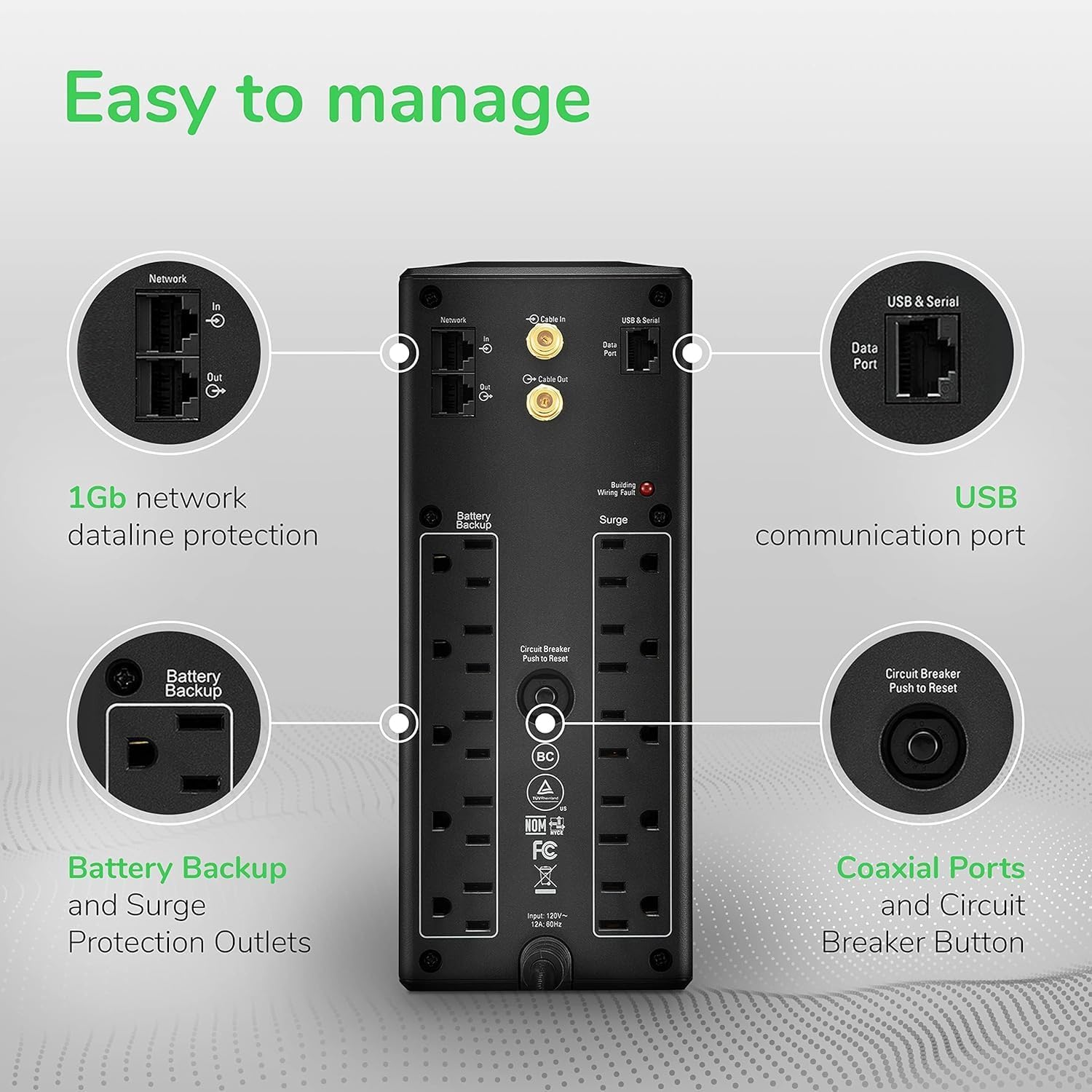
APC
$189.99
In stock on Amazon
Check price on AmazonMid-Tier: Lead-Acid Pure Sine Wave (CyberPower PFC Sinewave Series)
CyberPower’s PFC Sinewave line steps up from simulated to pure sine wave output while retaining VRLA lead-acid battery chemistry. This is the correct choice for buyers who need waveform compatibility with modern hardware but aren’t yet ready to pay the LiFePO4 premium.
As documented in Tom’s Hardware’s UPS Buyer’s Guide, the interaction between simulated sine wave output and Active PFC power supplies is a known, reproducible compatibility problem — not a defective-unit issue. Modern desktop workstations, most NAS enclosures, and virtually all Apple hardware use Active PFC supplies. Running these on a simulated sine wave UPS during a transfer event can cause abrupt shutdowns, which defeats the purpose of the UPS entirely and risks in-flight data corruption on any attached storage.
CyberPower pure sine wave models eliminate that failure mode. They retain the lead-acid battery replacement cycle (budget $40–$80 at years 3–4) but solve the waveform compatibility issue that makes budget-tier simulated sine wave units unsuitable for modern setups. For generator compatibility: CyberPower’s published generator compatibility guidance notes that their pure sine wave models with wide input voltage ranges are more tolerant of generator harmonic distortion than simulated sine wave units, though no UPS is designed for indefinite generator-primary operation. Always verify the specific model’s input voltage window against your generator’s output specification.
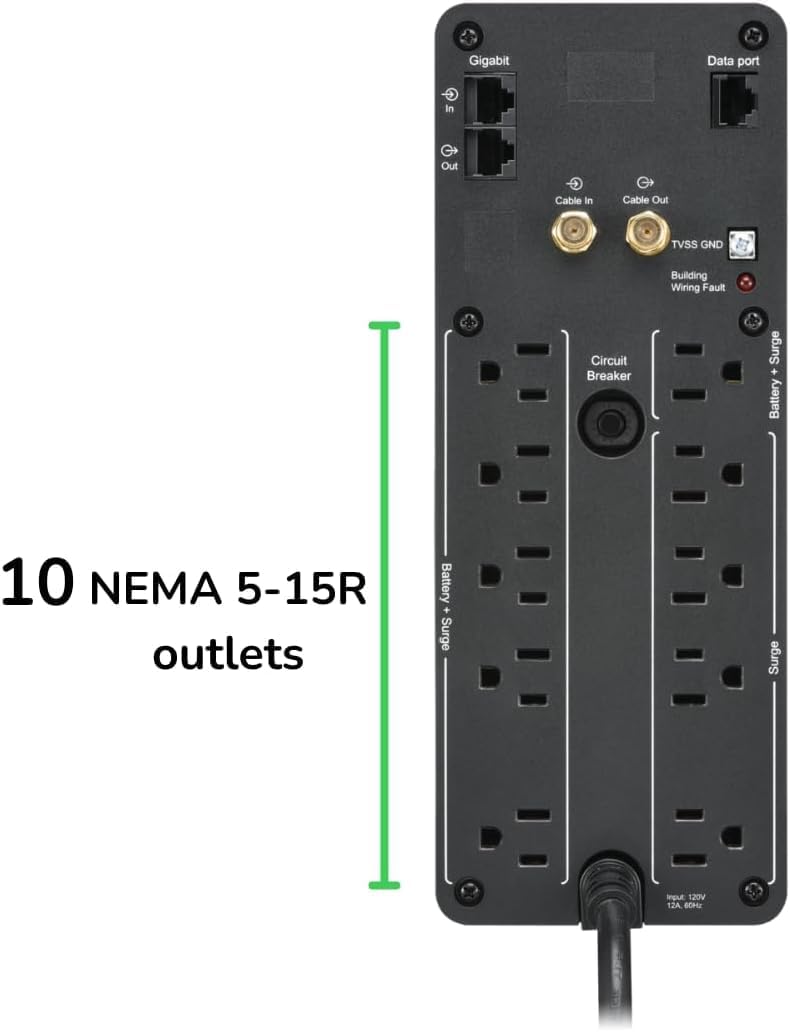
APC
$218.99
In stock on Amazon
Check price on AmazonPremium Tier: LiFePO4 Pure Sine Wave
LiFePO4 UPS units combine the waveform advantage of pure sine wave output with the chemistry advantage of lithium iron phosphate batteries. Both features come standard in this class. The upfront cost premium ($300–$500 for a 1500VA-class unit) is offset by the elimination of battery replacement cycles over the ownership horizon, as the TCO table above illustrates.
Tom’s Guide’s Best UPS roundup specifically flags lithium-based UPS units as the correct long-term investment for NAS and storage-attached applications, where the consequences of a dirty transfer event — write corruption, filesystem damage — are most severe. In grid-unstable environments (rural grids, frequent brownouts, flickering), LiFePO4 chemistry handles repeated deep-cycle events that accelerate VRLA degradation; the cycle life advantage (2,000–3,000+ cycles vs. 200–500 for VRLA, per Battery University BU-205) is most pronounced exactly when grid instability is highest.
For buyers in this tier: verify that generator compatibility is explicitly stated in the spec sheet if generator backup is part of your continuity plan. Not all LiFePO4 UPS models certify generator input, and the same harmonic distortion issues that affect lead-acid units can affect lithium units if the input circuitry isn’t rated for it.
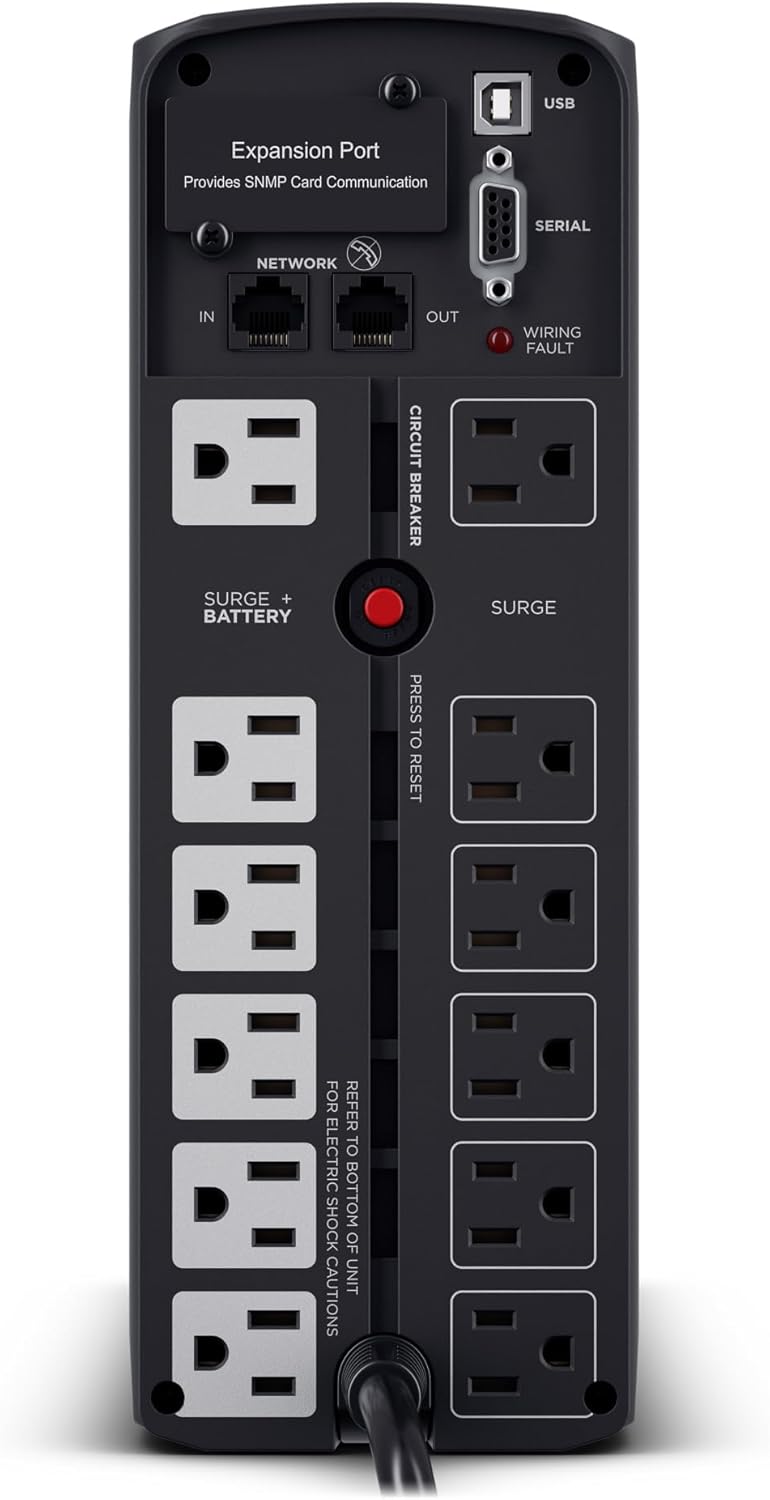
CyberPower
$239.95
In stock on Amazon
Check price on AmazonSine Wave Output: The Compatibility Issue That Actually Matters
Output waveform is arguably more urgent than battery chemistry if you’re running sensitive electronics — it determines whether your UPS will actually keep your equipment running during a transfer event, or cause it to shut down.
Your wall outlet delivers a smooth, continuously cycling sine wave. Simulated sine wave UPS units output a blocky, stepped approximation. For equipment with active power factor correction (Active PFC) power supplies — which includes most modern desktop workstations, current-generation NAS enclosures, and all Apple hardware — that stepped approximation can cause the power supply to interpret the transfer event as a fault condition and shut down.
Tom’s Hardware’s UPS Buyer’s Guide documents this as a known, reproducible interaction: the problem is waveform incompatibility, not a defective unit. The fix is pure sine wave output. PCMag’s UPS guide reinforces this recommendation specifically for storage-attached devices: any NAS where a mid-transfer shutdown could corrupt data should be on a pure sine wave UPS, not a simulated sine wave unit.
Decision rule: If your load includes any Mac, a modern NAS (Synology, QNAP, or similar), or a desktop with an Active PFC power supply — pure sine wave output is the correct answer. Simulated sine wave is acceptable only for older hardware and non-PFC loads.
Sizing Your UPS: The VA Calculation
VA (volt-amperes) is the capacity unit UPS manufacturers use. To size correctly: add up the wattage of every device you intend to protect (check the label or spec sheet on each), multiply the total watts by 1.6 to convert to VA (accounting for power factor), then add a 20% headroom buffer.
Example: NAS at 40W + workstation at 300W + two monitors at 60W = 400W × 1.6 = 640 VA, plus 20% headroom = 768 VA minimum. Round up to the next standard capacity tier — a 1000VA or 1500VA unit. Tom’s Guide’s UPS sizing documentation walks through this calculation in detail for common home-office and NAS-attached configurations and is worth consulting before committing to a specific capacity class.
One practical note on runtime: VA capacity determines how long the UPS can sustain your load during an outage. Most UPS units at typical home-office loads (200–400W) will provide 5–15 minutes of runtime at full rated capacity — enough to execute a clean shutdown, but not enough for extended outages. If extended runtime is a requirement, look at units with external battery expansion capability, or plan your generator interoperability carefully.
Frequently Asked Questions
Do I need a pure sine wave UPS for my NAS?
For most modern NAS units — Synology, QNAP, and similar — pure sine wave is strongly recommended. NAS enclosures with Active PFC power supplies can shut down abruptly on simulated sine wave transfer events, which defeats the purpose of the UPS and risks in-flight write corruption. PCMag’s UPS guide recommends pure sine wave for any storage-attached device where a dirty transfer event could corrupt data.
How long do VRLA batteries actually last before replacement?
In normal home or office environments (around 20–25°C ambient), 3–5 years is the realistic expectation. Plan for a battery swap at year 3–4, budget $40–$80 for the replacement cell, and source only from the manufacturer’s authorized parts channel to avoid counterfeit cells.
Is a 10-year LiFePO4 battery lifespan realistic?
Yes, for this specific chemistry. Battery University’s BU-205 documentation supports cycle life figures of 2,000–3,000+ cycles for lithium iron phosphate, and LiFePO4’s resistance to float-charge degradation makes 10-year calendar life a credible engineering projection for standby UPS applications — not a marketing claim. Operating within rated temperature ranges is the key contingency.
Will my UPS work correctly with a portable generator?
Conditionally. Consumer generators produce power with significant harmonic distortion that a UPS may interpret as an outage, causing it to switch to battery even when generator power is present. Pure sine wave UPS models with wide input voltage ranges handle this better. CyberPower’s published generator compatibility guidance recommends explicitly checking that your generator’s output regulation falls within the UPS’s rated input voltage window. Look for “generator compatible” language in the spec sheet — neither APC nor CyberPower certifies all models for generator input.
The Decision Rule
- Modern NAS, Active PFC workstation, or Apple hardware → pure sine wave required; LiFePO4 worth the premium at a 5+ year ownership horizon.
- Short budget, plan to reassess in 3 years → quality VRLA lead-acid from APC or CyberPower is rational; budget one battery replacement cycle.
- Grid-unstable environment (brownouts, rural grid, flickering) → LiFePO4 with pure sine wave is the architecturally correct answer; the chemistry handles repeated deep-cycle events that accelerate VRLA degradation.
- Generator compatibility in your continuity plan → verify the specific model’s generator input rating before purchasing either chemistry.
The data protects itself when the power stays clean. Get the chemistry and the waveform right, and your UPS becomes an invisible, decade-long asset instead of a recurring maintenance line item.